
“`html
Too many campaigns fail at the last step; not because the audience isn’t interested, but because the landing page doesn’t make it easy to say “yes.”
A lead generation landing page isn’t just a container for your form; it’s the bridge between interest and action, where curiosity meets decision. It’s the one place where your message, design, and offer must work together to earn a visitor’s trust and secure their details. The margin for error is small, but the payoff for getting it right is huge.
In this guide, we’ll break down the essentials and show you how to create lead capture landing pages that deliver new leads, optimize them for better conversions, and share real-world examples worth bookmarking.

What is a lead generation landing page?
A lead generation page is a focused web page built to capture visitor details in exchange for a valuable offer, such as a free trial, guide, or webinar. Unlike multi-purpose pages, every element is tailored to drive one action – converting visitors into high-quality leads.
Visitors typically arrive at landing pages for lead generation through:
- Paid ads (Google Ads, Facebook Ads, LinkedIn, etc.)
- Email campaigns with targeted offers
- Social media promotions
- Content upgrades within blogs or YouTube videos
- QR codes or physical marketing materials (for offline-to-online campaigns)
- Affiliate or influencer promotions
- Call-to-actions on a website or blog driving to a gated offer
For example, a person searching for “best CRM tools” on Google might click on a paid ad that directs them to a lead generation page offering a free CRM comparison guide, but only after they enter their email.
The traffic is intentional. The offer is compelling. The design is distraction-free. That’s what makes lead generation landing pages one of the most effective tools in a marketer’s toolkit.
Why use lead generation landing pages?
Every click costs time, budget, or opportunity. That’s why sending users to a generic homepage or crowded service page rarely delivers meaningful results. Instead, smart marketers rely on lead generation landing pages to capture interest with precision and purpose.
In essence, if you want to drive measurable results from your campaigns, a lead generation strategy is non-negotiable.
Here’s why they matter:
Laser-focused targeting
Unlike broad website pages, a lead gen landing page zeroes in on one specific offer, whether it’s a downloadable guide, a product demo, or a free consultation. This focus helps attract more qualified leads who are already aligned with what you’re offering, boosting both quality and intent.
Crystal clear call-to-action (CTA)
At the heart of every effective lead generation landing page is a standout CTA, one that tells the visitor what to do next. Whether it’s “Get the Free Ebook” or “Book Your Free Audit,” a strong CTA removes ambiguity and drives action.
Structured data collection
These pages are purpose-built to gather valuable customer insights, including names, emails, job roles, and preferences, through short, well-placed lead capture forms. This structured data fuels ongoing marketing efforts, enabling targeted emails, sales follow-ups, and personalized retargeting that keep leads engaged well beyond their first interaction.
Distraction-free experience
Unlike typical web pages cluttered with navigation bars and competing links, landing pages for lead generation are designed to keep visitors focused. No menus. No sidebars. Just the offer, the value, and the form.
Vital for mid-funnel engagement
These pages shine in the middle of the sales funnel, when prospects are no longer just browsing but are exploring solutions. A well-timed offer on a lead-gen landing page can nudge them closer to purchase.
Campaign-level performance insights
Each landing page for lead generation serves as a controlled testing ground. You can monitor traffic sources, form submissions, bounce rates, and conversion metrics, making it easier to track ROI and fine-tune your marketing efforts.
Cost-efficient lead capture
When executed well, lead-gen landing pages attract qualified leads, not random clicks. That means less waste and better returns from your paid ad spend or email outreach, a win-win for performance marketers.
Key elements of lead generation landing pages
Here’s a breakdown of the essential components that make up the best landing pages for lead generation, along with examples and actionable tips:
Message consistency
The landing page should deliver exactly what the visitor was promised in the ad, link, or search snippet that brought them there. Whether from paid search, social, email, or organic results, the offer, visuals, and copy must align perfectly with that initial message to avoid disconnects that break trust and drive visitors away.
Suppose you click an ad that says “Free UX Audit Template – download free” and the landing page mirrors it: same headline, short form, “Get the template” CTA, instant download.
Now imagine the opposite: the ad promises “download free with email,” but the page pushes “Start 14-day trial,” shows a long form, and hides the template behind a demo. This is a classic bait-and-switch that breaks trust and spikes bounce.
Clear value proposition
Your value proposition is the heart of your landing page. It should tell visitors, in just a few seconds, why they should care and why your offer is worth their time and attention.
- Use bold, benefit-focused headlines and subheads.
Keep it direct, not clever; clarity beats creativity when it comes to conversion. - Align your messaging with your ad or email source to maintain continuity of message.
Example:
SproutSocial: “Sprout’s unified social media management platform enables your team to extract real business value, strengthen your market position, and drive revenue, quickly.”
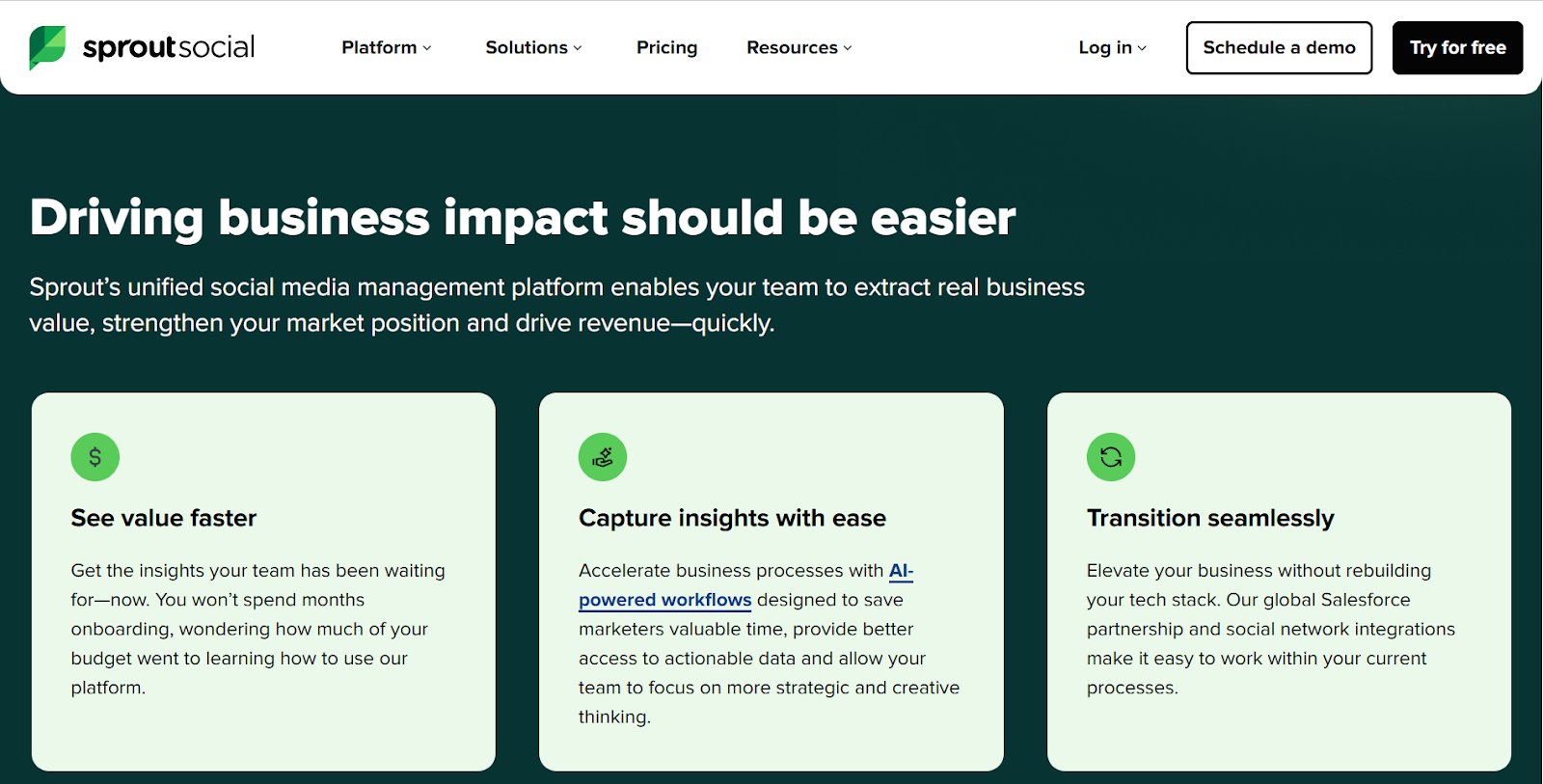
Why it works: This headline clearly states what Sprout Social offers (a unified platform) and directly ties it to meaningful business outcomes (value, market strength, revenue). It’s specific, benefit-led, and reinforces speed, which appeals to decision-makers looking for fast ROI.
Strong hero visual or video
Your hero image or background video should instantly communicate what your offer is about. Avoid bland stock images. Instead, show your product or service in action, or visualize the outcome users can expect.