Jump OS knowledge base · Foundation
What is Jump OS?
Jump OS is a public blueprint for building enterprise agent systems that can act without becoming impossible to understand, verify, stop, or correct.
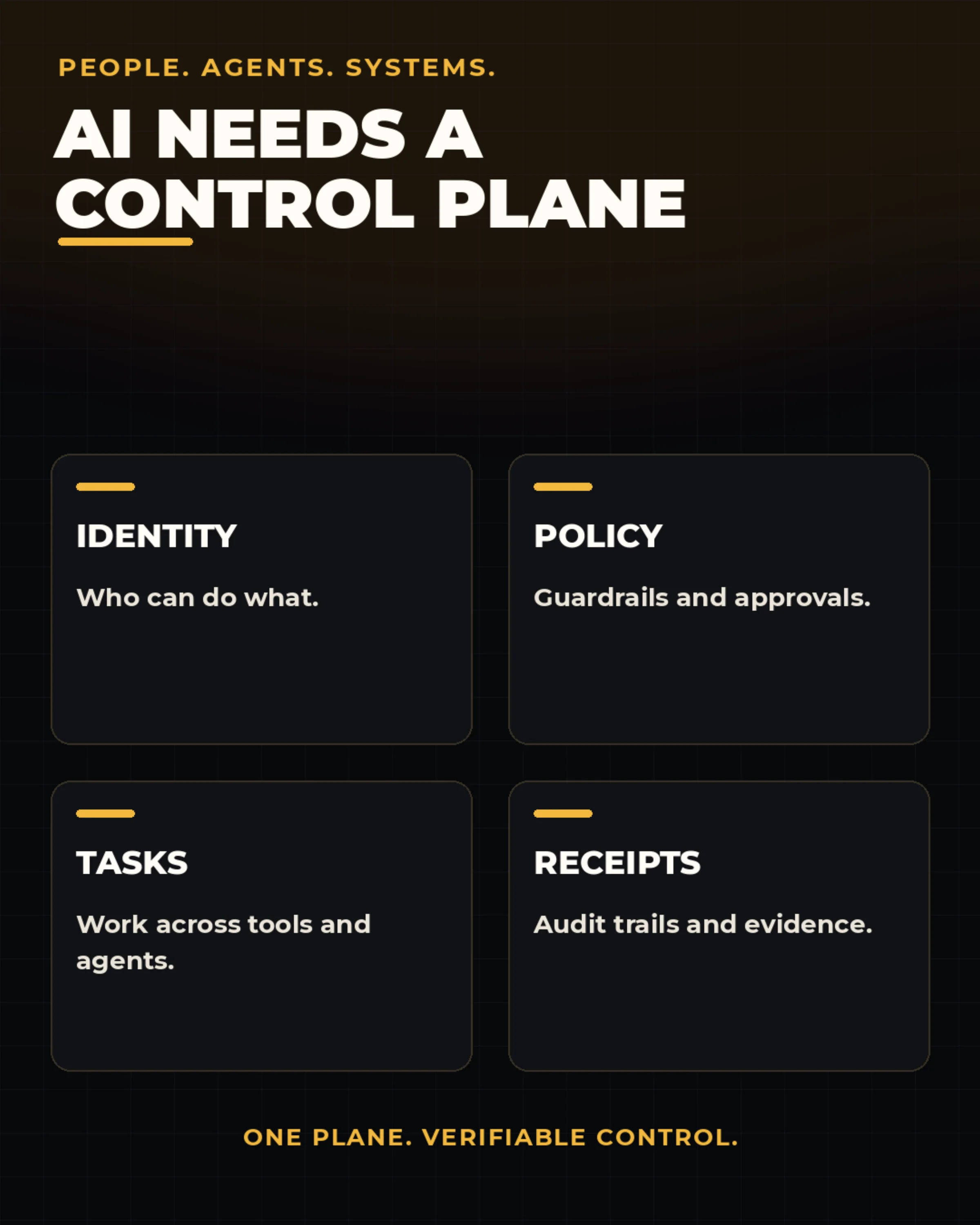
Control-plane visual
A system needs a boundary around the model
The public blueprint separates identity, task authority, policy, execution, evidence, verification, and recovery so a useful agent remains inspectable.
Read the control-plane guide →A control-plane blueprint for agents that do real work.
A chatbot can produce an answer. A script can call an API. An agent can plan and act across several systems. Enterprise work begins when those actions touch customers, money, records, permissions, regulated information, or durable business state.
At that point, “the model said it was done” is not enough. A serious system must answer: who asked, what was allowed, which task owns the work, which worker acted, what evidence exists, whether the result was independently verified, and what can be done if the outcome is wrong or incomplete.
Jump OS organizes those questions into explicit architectural boundaries. It does not prescribe the exact codebase. It gives an organization a language for deciding what must be true before an agent is trusted with consequential work.
What the blueprint covers
Identity and authority
Identity says who is making a request. Policy says what a rule permits. Task authority says which piece of work owns the action. Those are related, but they are not interchangeable. A worker should not become its own authority simply because it can reach a tool.
Evidence and verification
A response from a provider or worker is an observation, not automatically proof. Jump OS keeps evidence, result status, and independent verification separate so a system can honestly represent “accepted,” “unverified,” “failed,” or “unknown.”
Durability and recovery
Real systems retry, expire, time out, partially complete, and lose contact with workers. The public lifecycle describes how to preserve uncertainty and how rollback or compensation should be represented without deleting history.
Interruption
Emergency controls distinguish pause, cancel, terminate, quarantine, and rollback. A stop request is not proof that a remote side effect stopped. The system needs propagation, acknowledgment, and verification evidence.
What Jump OS does not claim
- It does not claim to be a production runtime or SDK.
- It does not guarantee safety, compliance, or successful rollback of arbitrary external effects.
- It does not require one programming language, cloud, model, database, or policy engine.
- It does not disclose Jumpstart Scaling’s private enterprise implementation.
Why this matters to a business
The value is not that every company should copy one stack. The value is that leaders, architects, operators, and security teams can agree on boundaries before implementation work becomes expensive. The same questions apply to revenue operations, research, finance, support, claims, and multi-agent applications.
Jumpstart Scaling can help an organization use the public blueprint as the starting point for a designed implementation. That work includes discovery, integration, authority boundaries, operational evidence, testing, deployment, and maintenance. The current enterprise offer is a $100,000 implementation with $25,000 annual maintenance, with final scope confirmed through an architecture conversation.
Continue with the canonical source
Read the public schema, examples, lifecycle, policy boundaries, protocol guidance, threat model, and emergency-stop architecture.
Open the Jump OS repository →